In the 1930s, Kathleen Bales was in her early twenties, and she was falling in love. Her parents, Charles Vincent Bales and Minnie Viola Phillips had married in Kentucky, then traveled to the John Day Valley to settle, where Kathleen was born in 1912 along the South Fork of the John Day River.
Maybe it had something to do with the river, the John Day River was a lifeline for the early ranchers of the Valley. There was an attraction there, not just for the water, for fishing or swimming, or irrigation, but merely for its presence and impact upon that landscape.
Kathleen, who grew up on the Bales Ranch in the early 1900s, shared her memories in a 1983 interview recorded on an old cassette tape at the age of seventy-one. During the interview she was asked what people did for courting in those early days. Listening to her voice on that old tape you could almost see her face light up as she remembered her past. With a smile you could hear in her voice she replied, “Charles and I would go down and watch the dredge operate.”
There are few people today who remember watching the giant dredges chew through the landscape in search for gold. But it took a marvelous engineering feat to build them and the fascination with these giant machines remains. The restored dredge at Sumpter, Oregon draws thousands of visitors each year just to behold such a thing.
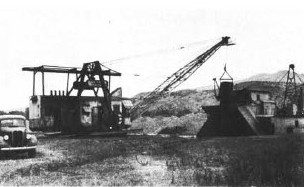
Charles knew the co-owner of the dragline dredge, Joe Ferris, and Kathleen recallsed the colorful stories told about him. She told how he used to be a rumrunner, about his trips hauling gold to San Francisco, the fancy top hat he wore when the opera came to John Day, how he kept a suite of rooms at the hotel in John Day where his wife stayed, “…a lovely person, but she just stayed there, he didn’t expect her to keep house or anything.” She recalled that Ferris died in an automobile accident, after a successful career of running dredges in Idaho, Oregon, and California.
Ferris and his partner, Joseph Marchbank, used a drag line dredge and worked about 5 miles west of John Day. The capacity of their machine allowed them to process about 6000 cubic yards a day, and at the time was one of the largest, if not the largest, dragline dredges in the world. It is little wonder it attracted people to watch it work.
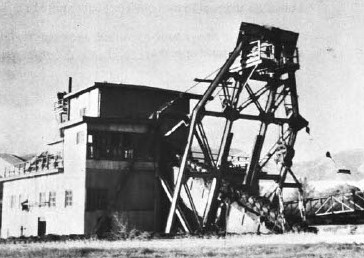
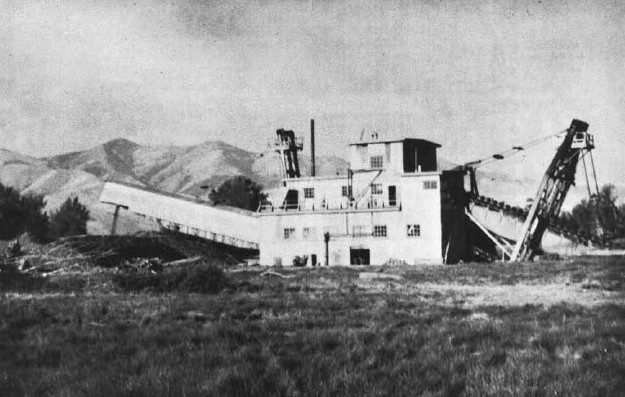
At the same time there was another dredge working through the Valley, and it was indeed a formidable machine. As Nick Sheedy stated on a post to Forgotten Oregon in 2018, “Starting in 1937, The Consolidated Western Dredge Co. of John Day (soon changed to Western Gold Dredging Co.) began operating a large connected bucket dredge near the confluence of Canyon Creek and the John Day River (the old “China Diggings” placer ground, which had been worked over several times). It dredged about 6.5 miles along the John Day Valley from about 2 miles above town to 4 miles below town, including most of the dredged ground along the present river channel within the city limits of John Day. It worked its way down river until it came to where the Ferris & Marchbank dredge was operating above Mount Vernon, then dredged back to John Day adjacent and parallel to its first run.” The photo headlining this story shows that impressive bucket dredge.
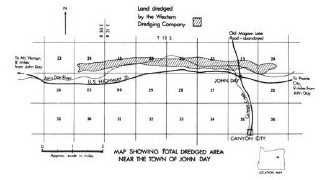
On the north side of present-day John Day City, a shopping center, a former trailer park, and other businesses, were built upon the tailings (rocks spewed behind the dredge). The dredges did not work in the river itself, but rather, followed the course along the banks and fallow land adjacent to the river (though in a couple places, it did alter the actual course of the river).
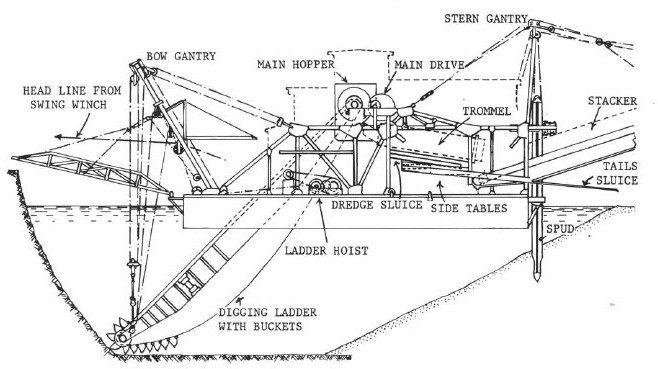
This cross section illustrates how the massive machine worked. “The area where dredging began was known as the Old China Diggings and was the richest land ever worked by the dredge. The China Claims were rich placer deposits which had been worked around the turn of the century by Chinese laborers using shovels, gold pans, rockers, and sluices. The early-day mining ventures had attracted the Chinese to John Day, where they had built their own little Chinatown.
From the town of John Day, the dredge followed the John Day River west to the property of J.H. Ferris and J.W. Marchbank, roughly halfway between the towns of John Day and Mt. Vernon. Ferris and Marchbank were already operating a dragline dredge or “doodlebug” with a 4 1/2-yd bucket and a floating washing plant that contained a hopper for receiving gravel dug by the dragline, a revolving screen, riffled sluices or a revolving pan amalgamator, and a tailings stacker.
From this point, the Western Gold Company dredge turned around and went east back to John Day. dredging just north of the earlier dredged land. When the dredge came to the place where the road crossed the river, it was stopped until an agreement was reached with the city to tear down the bridge, run the dredge through and build a new bridge. Then the dredge followed the river east for about I 1/2 mi. until it became unprofitable to operate.”1
Nick Sheedy, in that post to Forgotten Oregon, provided a very rare look at the dredge in action. During the summer of 1938 his great-grandfather, the late J. George Sand (1900-2000), captured footage of the working dredge on his Keystone 8mm camera — on one of his summer trips from Ohio out to Oregon to visit his uncle’s Isaac Gucker and Daniel Gucker who mined on Little Canyon Mountain. The film was passed down to family members, and in the 1990s, with the assistance of the Oregon Historical Society, was converted to VHS, and then digitized by Nick. As far as it can be said, it is the only live footage of a working dredge in the John Day Valley, and Nick has kindly offered it to be shown here:
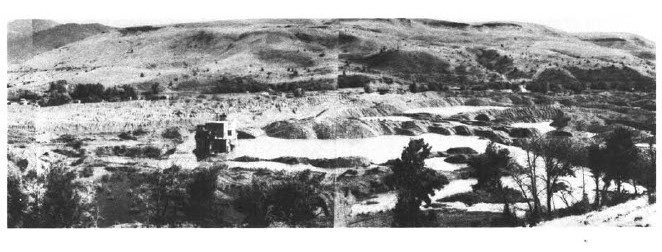
This old composite photo, though difficult to discern, shows the dredge floating just left of center, surrounded by tailings, the city of John Day to the far left. There is no question that the use of these dredges, and mining in general, inextricably altered the landscape. There are those who tend to shudder at the dredges’ impact on water quality, fisheries, and the arable land alongside these waterways. As F. W. Libbey stated in 1939, “There are those who make the impassioned plea, “See those acres of dredge tailings! They look like hell and think of the ruined land we are leaving for posterity.” On the first count we are indeed licked; tailings not only have no esthetic value, they are offensive – as much so or more than a stretch of hundreds of acres swept clean by a forest fire or the thousands of acres of cut-over stump land up and down western Oregon. It is indefensible.”2
But Libbey goes on to study the problem in depth, reporting his findings under the title, “Dredging of Farmland in Oregon“, published by State of Oregon’s Dept. of Geology and Mineral Industries. While acknowledging short term impacts, he carefully analyzed the impact on arable land, economic impacts, as well as environmental considerations and concluded that, with oversite, reclamation and re-soiling, the impacts could be minimal in the long run.
Specific to the John Day Valley he stated, “The John Day Valley has been considered a critical area because livestock is the principal money crop and the hay land of the valley, some of which has been dredged, is essential to provide winter feed. The small amount of hay land dredged would probably have little effect on the total amount of winter feed available, but, aside from this, measures are being taken to improve the winter feed condition – measures which would have been taken had there not been any valley land dredged. The most important of these improvements are the progressive replacement of meadow hay land by alfalfa land in order to increase the amount and quality of winter feed, and “deferred” or planned grazing designed to improve the quality of range land contiguous to the valley.“2
It is interesting to note that the Western Gold Company dredge, from just east of John Day to where it turned around at the Ferris dredge, disturbed less than 800 acres, much if it through brushy and swampy land near the river, and through the existing Old Chinese Diggings. Considering there were nearly 31000 acres of irrigated farmland in the Valley, the overall impact, while unsightly, was minimal compared to the whole.
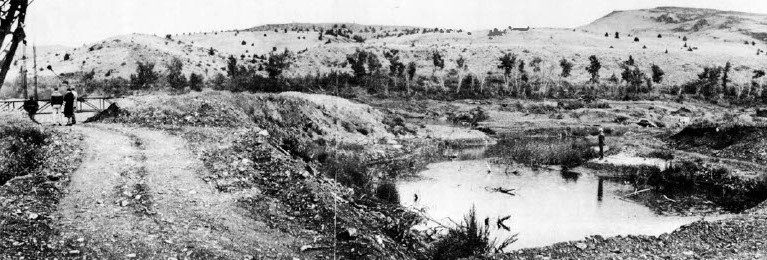
Western Dredging Co dredge extreme left
Mining in the area had begun 70 years prior to the arrival of the dredges when gold was discovered near Canyon City in 1862. Whether you hike up Pine Creek near Prairie City to the flanks of Strawberry Mountain, or hike through the hills around Gold Creek in northern Idaho, or travel through the Shasta Mountains, there is virtually no place in the western states where traces of past mining operations cannot be found. The disturbance to the landscape aside, it goes without saying that the quest for gold created towns, commerce, and opportunity in the settlement of western States.
It is somewhat refreshing to read that even in the 1930’s, well before the formation of land use laws and regulations we live by today, people were already considering reclamation and economic impacts and seeking ways to ameliorate the environmental damage.

And it is equally refreshing to imagine an old woman’s memories, of the day when she and her beau would wander down to the river, watching that fantastical machinery work, holding hands, dallying at the dredge amidst gold and love.
Sources
- The Western Gold Dredging Company of John Day, Oregon by John T. Leethem, geology student, Oregon State University. Oregon Geology, Vol. 41 , No. 6, June 1979 https://d3itl75cn7661p.cloudfront.net/dogami/og/OGv41n06.pdf
- Dredging of Farmland in Oregon by F. W. Libbey, State of Oregon, Department of Geology and Mineral Industries, Bulletin No. 19, 1939 https://d3itl75cn7661p.cloudfront.net/dogami/B/B-019.pdf
- Gallery of photos from two sources above. Photo of Kathleen from family collection.