John T. Hammack Leaves to Posterity Interesting Autobiography
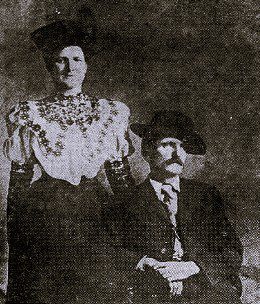
As printed in The Idaho Statesman, Sun, Sep 15, 1935
Editorial Note: John T. Hammack, who died last July at his Boise home, had a colorful and varied career. When his eyesight and failing health prevented him from continuing his mining development, he spent hours dictating his memories to his son and daughter-in-law, and they compiled it a few months ago. He was 83 the 15th of last February. In dictating the story, the past became so vivid to him that it seemed “only yesterday” when it all happened. The story is printed through the courtesy of Mr. Hammack’s sons, Bryan and Berlin.
I was born in Granville, Texas, on the banks of the Red River I suppose if my father, Thomas Porter Hammack, had not been killed in the Civil war (Castle, Mo., in 1865, under the command of General Price) and his Elkhorn tavern swept away by a battle fought on that site, I never would have seen the west. My father, a southern gentleman of the old school, owned considerable holdings and he probably would have continued on there for the rest of his life.
As it was, he was killed and all wealth and possessions were swept away during the war, leaving my mother and I stranded. I was about 7 years old. Very soon my discouraged mother married a widower whose eyes turned toward the west because of reports drifting in about fabulous sums taken out of the earth in the form of gold.
So it was my stepfather, accompanied by my mother, his three children and myself, joined a train of 59 wagon in 1867 for the land of the golden west. We only started out with four wagons but since people heard we were coming joined us at every crossroad until the train was composed of 59 wagons. [His stepfather was Stokely D. Wilson 1818-1874. His three children were from a previous marriage to Louisianna Chenowith and all three would go on to marry children of Nathan and Esther Fisk, this editor’s 3x grandparents].
We drove through the Cherokee nation until we reached the Grand river where we lay over because of the high water. Finally, Thomas Tucker, captain of our train, a fearless man of powerful physique, managed to secure someone to ferry us across the river. Some of the oxen urged to ford the river were swallowed up by quicksand and the last we saw was the horns going down. This remains a vivid memory to me. Before we left the banks a negro, accompanied by a white woman, who he claimed was his wife, rode up and wanted to become leader of the train. Big Tom Tucker, a man of quick temper, shot him down.
Soon we were rounded up by government inspectors who examined all the wagons for liquor. My stepfather, being an invalid, was allowed two quarts of liquor but all the rest was confiscated for fear the Indians would get hold of it. At one point in Kansas my stepfather became so ill it was necessary to put him on the new Union Pacific line and let him ride as far as the road was built.
Buffalo Bill Guarded Train
We made various camps along the way until we reached Denver. Here was a small but booming mining town, with board sidewalks, saloons, and hotels. Even though I was only about 9 years old at the time it left an impression as being the prettiest country I had ever seen. Wildlife was abundant. Pushing on to the west, we ran into the Sioux Indians, who were on the warpath.
Buffalo Bill, accompanied by a hundred picked men and riding fine government horses, guarded our train for 150 miles. Buffalo Bill was my ideal when he rode through the camps straight as an arrow and impressive with long flowing black hair. He directed us to corral our wagons at night, pushing the tongue of each wagon under the back of the other until it formed a solid circle for the women and children, who were made to stay inside.
During the 150-miles trek Buffalo Bill, aided by some of our men, had many skirmishes with the Indians. When we succeeded in keeping them away from the train proper they tried to steal the straying horse, We finally came to Bitter Water country that was alive with Indians. These were either Bannock or Piutes.
After camping at Green River City for a few days to rest up and feed the stock, we pushed on up the Green River to its head. My stepfather had joined us about this time. At what place or how I can’t remember. It was along this route or at Medicine Bow that we had to throw the wagons into a circle to keep a herd of several thousand buffalo from stampeding us. They were headed for the northern country and it took them two hours to pass before the train Hamilton relieved of danger.
We stayed at Fort Bridger City for a few days to rest up and feed the stock, we pushed on up the Green river to its head. My stepfather had joined us about this time. At what place or how I can’t remember, it was along this route or at Medicine Bow that we had to throw the wagons into a circle to keep a herd of several thousand buffalo from stampeding us. They were headed for the northern country and it took them two hours to pass before the train was relieved of danger.
Crossroads of West
As I remember it, it was at Steamboat Sprins that we reached the great crossroads of the west. One led to the California gold rush and the other led to the Oregon territory. Here the train split up, almost equally dividing. I don’t suppose coins were flipped, but it was hard to determine which road held the greatest fortune. My stepfather chose Oregon. So our 25 wagons came down the Oregon trail, losing only three or four wagons to settle along the way, and picking up two or three wagons whose personnel settled in Boise. Among them I remember the Hunt and Hurt families, a Mr. Bryson and Dude Cavin.
We crossed the Malad or Lost river by boat. While on the water, a woman shot her husband for being unfaithful and he tumbled into the river; he was rescued, but I don’t know whether he lived or not.
We came down the Snake River and followed the old Overland stage route to Black’s creek. Black’s creek was named after the late Mrs. Ridenbaugh’s father, Frank Bleck, her brother, was established in a grocery store in Boise.
We reached Boise by fording the river at Ninth street. We camped in what is now the main street of Boise. The people here were so glad to see the train and were so anxious for the travelers to settle that they threw open an old landing shed fronting on Eighth street (the present site of Idaho Hardware) and told us to help ourselves to pumpkin, corn and other produce. My mother wanted to stop and locate in Boise, but my stepfather wanted to push on to the Oregon country, because he thought gold grew on bushes.
By easy stages we reached Eldorado (Malheur City) now and found a rich mining camp. In order to work that property and to show their great faith in the country, the locaters built a ditch 80 miles long. We crossed over into the Blue mountains. Here a lot of Indians were encountered, but these tribes were of a civil nature. Before this however, much blood was spilled at Castle Rock by fights between the Indians and whites.
Paradise for Stock
So crossing the Blue range we headed into John Day valley and thence to Prairie City. All this country was a paradise for a stock range and farming center. Prairie City was a promising placer and quartz mining camp, We located a Dixie Creek, a placer camp located by southerners, and here my folks bought property and built a large boarding house and hotel and called it the Wilson House.
It was the mecca for prospectors and travelers. Schooling in a mining camp was limited. Ours was that of experience, although I really learned to read and write from a gentleman who drifted in from the gold fields of California. The life of the new west was humming; Indian scares, roundups, mining prospectors, crowded saloons and much gun play. My half-sister and I held a man’s dog while he went up the hill and shot out a dispute with his partner. He said if he didn’t return by sundown the dog was ours. We kept the dog.
At a very young age I probably was a good rider else my stepfather wouldn’t have made me go on a trip that almost lost me my eyesight. The government gave two men by the name of Becky Forgitt and Charlie Merritt a commission to take provisions to the Malheur Indian agency. The Indians, friendly by now, had been pushed out of their hunting grounds by the whites, and along about February when the snow was six to eight feet deep they began to starve.
When Charlie Merritt looked for someone to ride the bell mare of the 40-mile pack train my stepfather said that I was to go. It was zero weather and all except the major domos, Charlie, Becky and myself, were Mexicans. I was the only kid in the bunch. It took about six or seven days to go 14 miles. We could travel only in the morning as long as the snow crust was frozen hard enough to hold up the heavily laden mules.
Before we reached the Blue mountain summit and Flag prairie I was almost crazy with the glare of sun on snow. To make matters worse the big Palomino horse carrying the jaquimas filled with grub stampeded and ran away, destroying all the provisions the crew used. We had to break into the government provisions for something to eat.
Suffers Snow Blindness
But going without grub wasn’t anything compared to the ache in my eyes. When we reached the summit I had gone completely blind from the constant glare of the snow.
I didn’t understand that the Mexicans blacked their eyes, because they were so dark anyway. No one told me how to care for mine. My eyes got so bad they tied me to the mare until we reached the old Malheur station deserted except for winter emergencies.
Here stage teams were fed and watered in summer and mail carriers dropped by here on snowshoes occasionally during winter. They left me in the cabin alone with provisions to last a day or two and promised to come back. I groped about three days and finally heard a noise and Charlie Runnels, who was carrying mail from Vale to Prairie City happened by.
His route didn’t bring him by the cabin at the foot of Iron Mountain but for reason which I can’t remember, he came by the cabin. He put me in the toboggan sled, hobbled his snowshoes and pulled me and the mail bags up to the summit. Then 14 miles down hill until we hit the head of John Day swollen badly. At John Day he secured a team and took me to the new doctor in Prairie City. Years later a Chicago specialist said that snow blindness caused my cataracts from which I suffered later in life.
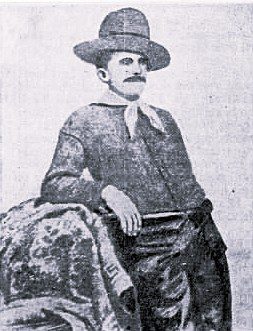
I had good health and was soon out working. A little older and I was out riding the Blue mountain ranges for J. J. Cazout, a cattle man [He is probably referring to T.J. Cozad, 1838-1909]. I wore buckskin clothes, was lithe, built for the saddle and they called me a hard riding cowboy.
Courageous Cowboy
I didn’t think I fit the name with the degree that old Dan Flanner did. Dan, an older devil-may-care rider in our outfit, said he could ride any horse in the country. They brought in a wild mustang that no sane cowboy would have attempted to ride. Dan never hesitated and rode the wild cayouse alright. Stuck to the kicking and rearing outlaw over 10 acres of flat land. Dan won and lost. The horse gave one last reared plunge and then foaming and trembling stopped still. There was a funny twinkle in Dan’s eyes as he said, “I rode him, didn’t I?” Then he slid from the horse’s back like a sack of meal. He only lived an hour.
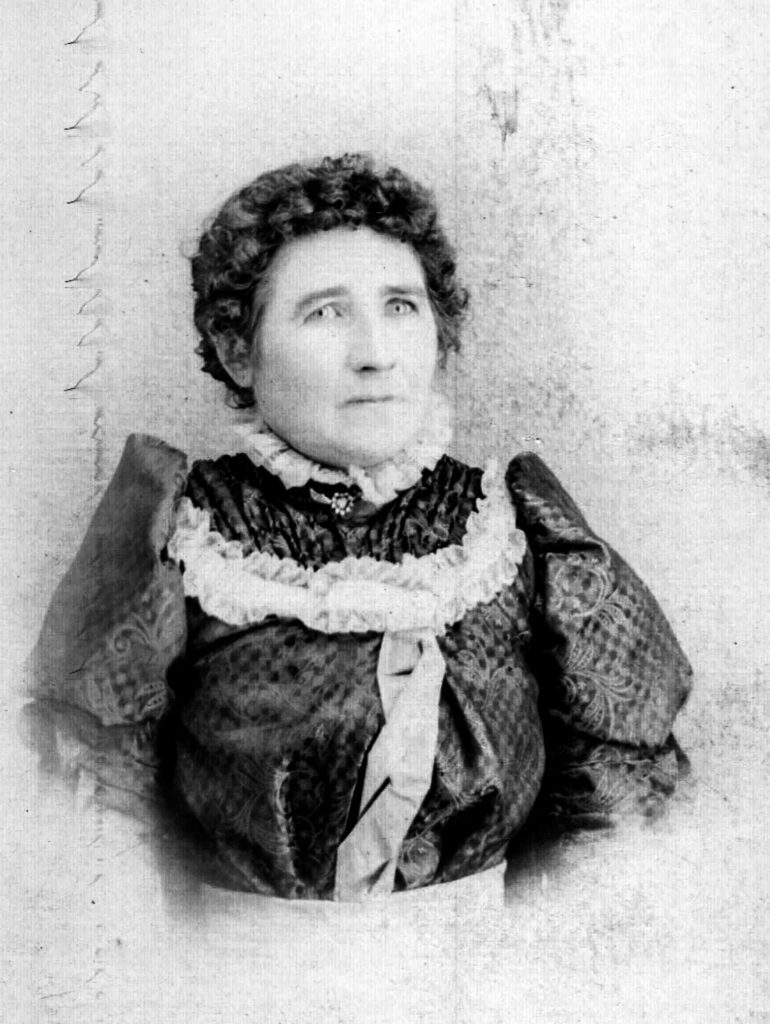
I made infrequent trips down to see my folks. My pal and confidante was my step-sister, a tall fine girl with hazel eyes and nut brown hair. Among her admirers at this time was Red Dawson. He was an outstanding personality at the time, commanding a certain respect and awe wherever he went. Mary had a mind of her own, however, and finally chose a man of quieter nature and more settled disposition. I don’t know whether Red Dawson got drunk and went out and shot up the town or not, although the chances are he did, as this was an old time custom but soon after he hit for the gold fields of Alaska and had the distinction of having Dawson, Alaska, named after him. [This stepsister was Mary Wilson, the daughter of Stokely Wilson who married John’s mother after the death of his father. Mary was married to Nathan Fisk, the 2nd great-granduncle of Mark Goddard, transcriber of this autobiography].
About this time, 1877-78, I joined a garrison of soldiers stationed at Prairie City, under the command of General Otis. I served as scout under the immediate command of J. J. Cazout [Again, possibly T.J. Cozad], my range boss, who was made captain when the uprising started. This was during the Bannock war.
Scout Finds Bride
The post was maintained until 1880 and the Indians were under control by this time. It was while stationed at Prairie that I met the brown eyed girl, Amber Cooley. Her mother, a strict, severe woman, ran a boarding house. We boys going over from the garrison for extra meals from after a heavy meal in the post, ordered a meal because it was the only way for me to see Amber.
Sally Sweetwater, Indian princess, coming into Prairie for her tribe, grew to think there was no one quite like brown eyed Amber Cooley. She brought her beads and blankets and called her White Fawn. It was during Amber’s few trips to carry messages to Sally and thus to the tribe that I grew to know the Prairie City girl. I was still acting as scout, and I was elected to see that no one was to receive harm from the Indians. My duty watching Amber was the greatest pleasure. At this time, I joined the Prairie Masonic lodge and have been a member over 50 years.
My folks sold their holdings at Dixie creek and moved to a ranch at the head of Strawberry valley under Mount Logan [Strawberry Mr.]. This was a placer claim where a million dollars of gold was washed out. Later attention was turned to quartz in this section.
When I was about 23 the famous cattle men of Texas by the firm name of Lang and Ryan sent their buyers and cowboys up into Oregon and southern Idaho to buy cattle. They paid $10 a head notifying people for miles ahead to brand the cattle they wanted to sell with the bar circle and have them ready to join the herd. Billy Lang, adopted son of the cattle king, being the majordomo of the outfit hired me to ride. Tom Ballou was assistant majordomo.
They had been buying cattle in Prairie City for four years before I consented to hire out to them and at an unheard of wage in those days of $125 per month. Then 10 bands, one band straggling out over the mountains after another was hard to control, breaking out now and then in stampedes that lost us many head. They went back to stamping ground, or fell into the hands of anyone who corralled them.
It seemed months that we were on the trail without a word from back home. I kept thinking of how Amber had tried to dissuade me from coming on the trip. With a woman’s intuition she felt that if I went I would never come back, so I promised to turn back once we reached the border. We finally, after day upon day of trailing bawling, milling herds, fording rivers and scraping through heavy undergrowth of canyon, came to the Pecos river and at the point to where I decided to turn my horse’s head back north and home. It was afternoon and we took time to consolidate the 10 herds for the last trek.
Promise to Sweetheart Saves Life
I told Billy Lang I was quitting and he refused by offering me $150 to stay on. When I still refused the cowboys of the outfit thought for sure I had gone completely loco and said if it was a girl that another half hour’s ride would bring me to the prettiest dark eyed girls on the border. I had made someone a promise and I was going to keep it, so I was soon headed back to Oregon.
Within 12 hours from the time I left them all 18 cowboys including Billy Lang were killed by the Mexicans and the herds scattered to the four winds. The news reached Prairie City before I reached home and everyone thought I was killed. (The Lang and Ryan herd was mentioned in a recent western pioneer picture “West of the Pecos.”)
I was married immediately to Amber Cooley and settled soon after in Burns, Ore., where I had a blacksmith shop. In turn I ran the stage line to John Day. All this time I was hearing about gold in the Boise basin and it wasn’t long before my wife, children and I were headed for the Boise valley. Always interested in horses, I brought eight span of perfectly matched horses with me.
Boise had grown considerably since I had seen it as a child with the Overland hotel as the center of activity. There was much mining activity in the Boise basin, but except for driving stage for a while I never had much to do with that section of the country. Thorn Creek, Rocky Bar, Bernard Mountain country drew my attention as the years passed but it was while I was driving the old Overland stage route that I became interested in the Neal mining district.
Nowadays men stand very little of the hardships of riding stages, unless they have a heated car. In those days I arose at 4 o’clock on cold winter mornings, when the temperature was below zero, fed, watered and hitched my team and was ready to carry the mail seated on an open seat in the drive of the storm. In time my feet, hands and ears have suffered frost bite, but the mail was delivered. I didn’t have a newfangled heater but I carried a little yellow jug of Old Crow.
With this same mail stage team I later hauled stone from a quarry at Table Rock that went into the building of the penitentiary, Natatorium and the old depot.
Locates Mine
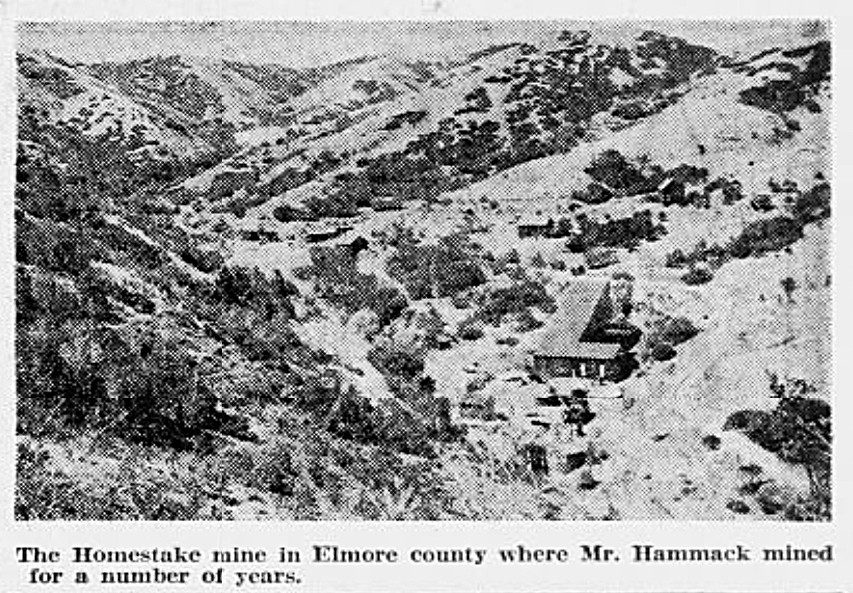
At this time Old Man Neal had founded the Homestake mine and sold it to Balbach for $40,000 cash. My interest being at fever heat sent me into the hills where I located the Rose Bud not far from the Homestake.
Up to this time and years after I was interested in mining claims with many fine characters: William McKinley, Barney Coleman, William Alley, Joseph Hammond, Pittsburg and Mr. Cobb of Boston. Later there was J. R. Compton and J. R. Good.
It was to young Cobb I sold the Rose Bud for $40,000. He paid $10,000 cash. This was about 1906 and now being confident that money was coming free and easy, I spent the down payment on the mine with the abandon I used to trade a sack of gold dust over in Oregon. I didn’t foresee that young Cobb, a fine looking young man fresh from college, would become involved with a woman and just chuck everything and leave the country.
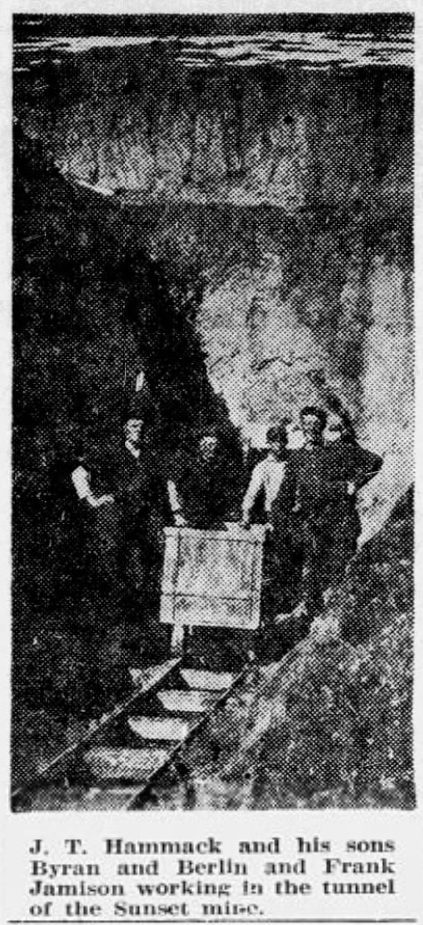
I located the old Corder claim that was sold some years previous for quite a bit of cash money. The Homestake mine was going full blast now and the hills were full of prospectors, and the rough roads were filled with the music of bells on four or six-horse freight wagons. From this time until the Homestake changed hands it was estimated a million dollars was taken out. Gold was profitable and no one could forecast the long lean depression years when the price of gold and silver was down. I stayed on year after year when the hills finally became deserted. I stubbornly clung to my dream.
As to progress in Boise – I came to the city when the supplies were brought in from the Dallas by freight team – I saw the first street car system installed in Boise. There was the first motion picture house. Because of the novelty I took my family. It was a travel picture. That was one of the only two motion pictures I ever saw thus far. Later in years there was the coming of the main line – the first flight air mail and then the other day I saw the new Deisel engine streamline train. Progress has more than caught up with the flight of years.
So the years have passed and again gold is profitable and a new mining era has commenced. For me the zest has gone—gone when my wife and partner of 50 years was laid to rest [Amber died 3 Nov 1933 and is buried at the Morris Hill Cemetery in Boise, Idaho]. Spring comes again and once again as I stand at the window watching the snow melt from the peaks I find the old fever of getting my grubstake together and going into the hills has diminished. That spell of the hills and gold is broken and I am freed from the enslavement.
Soon again we must be leavin’
For a distant western goal.
Pioneers—all hitched an ready
When the leader calls the roll.
This last spring time after time he stood at the window watching the snow going off the peaks near the Homestake mine. The habit of many years was keeping him there wondering how many more times he would see those mines from the summit. But the intense fire has gone from his eyes and then I hear him absently humming, “One More River.”
[Editor’s note: Spelling and grammar left intact]