Winifred Jennings Cowley (1859–1924): A Frontier Witness and Advocate for Native Sovereignty
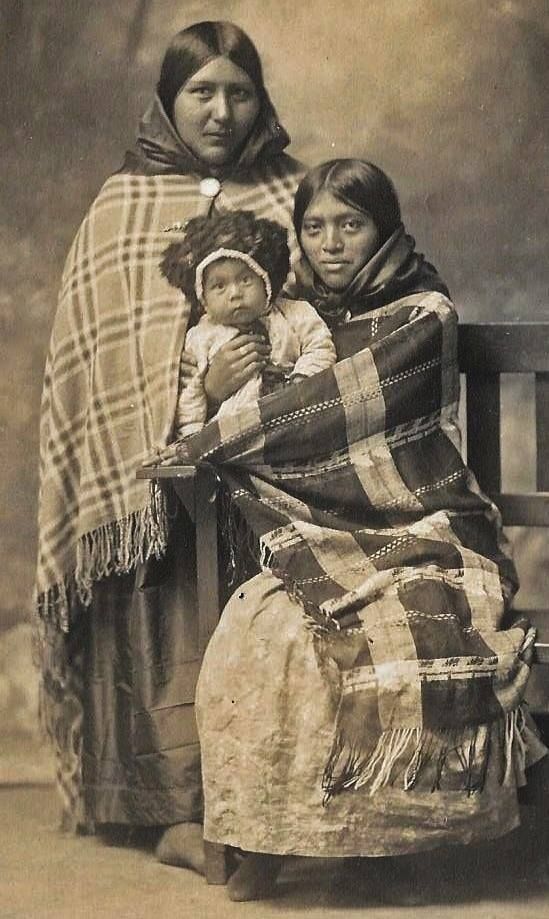
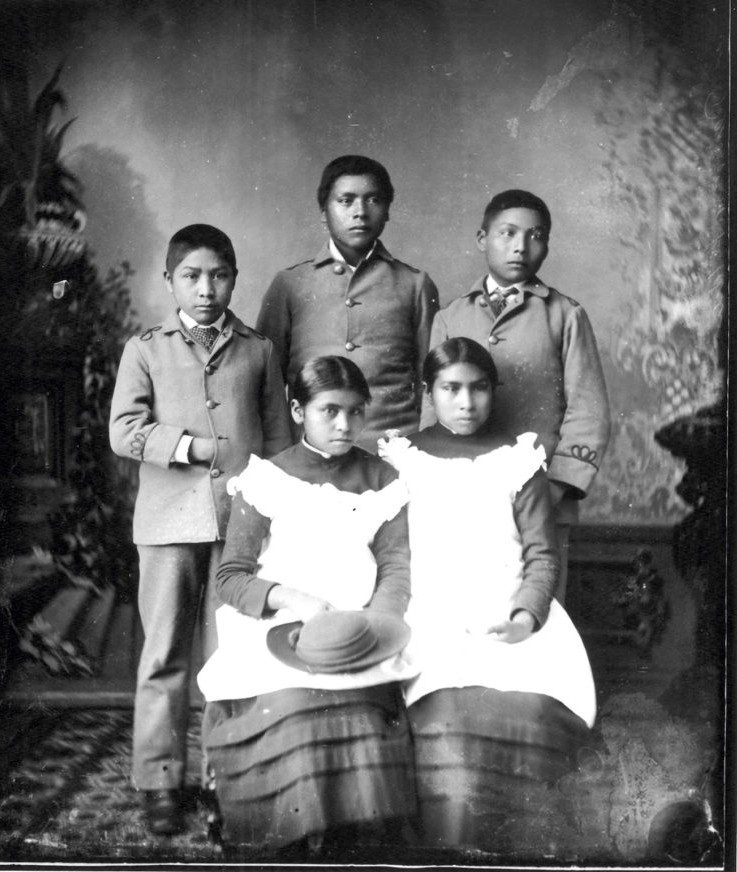
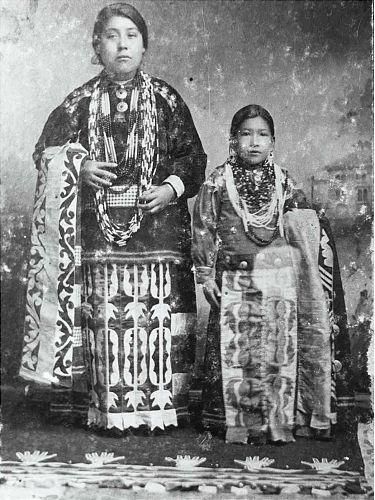
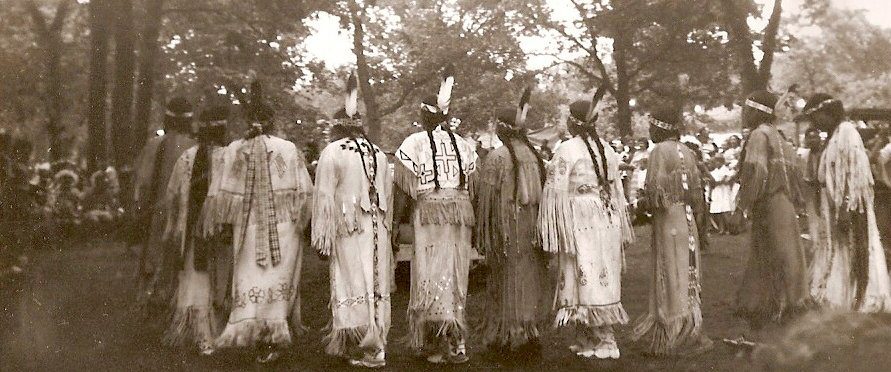
In a blog post on the Josephy Center for Arts & Culture website (Friends of Indians, 1888 | Josephy Library of Western History and Culture) Rich Wandschneider introduced the authors George Truman Kercheval and Alice Cunningham Fletcher. The topic of his post centered around the Dawes Act of 1887 and the goal whereby individual Indians on owned parcels would, in giving up the concept of tribal or common lands, become Americanized.
Besides his main topic, Rich also introduced a mystery. He dug into a story titled “Three Men of Wallowa” by George Truman Kercheval, and, curious about the author, found a hint indicating “the author might have been “Mrs. George Truman Kercheval,” with “Mrs. Winifred Jennings.””
This raised my curiosity as well. Not only a mystery writer about the Dawes Act, but the name “Jennings” which, in the back of my mind, I remembered existed within my own family tree.
A quick search and tentative play with AI only deepened the mystery, for I came upon a misleading clue indicating George Truman Kercheval was the pseudonym of Winifred Alice Dixon (1866–1891), an American author and activist known for her late 19th-century literature advocating for the rights and preservation of Native American cultures.
Sounding like a promising lead, it only led to more confusion as to the author of “Three Men of Wallowa”, for there were no records of a Winifred Dixon. Like any search engine, AI assistance needs to be taken with the proverbial grain of salt as it only assembles information from what it is given, with few claims to accuracy.
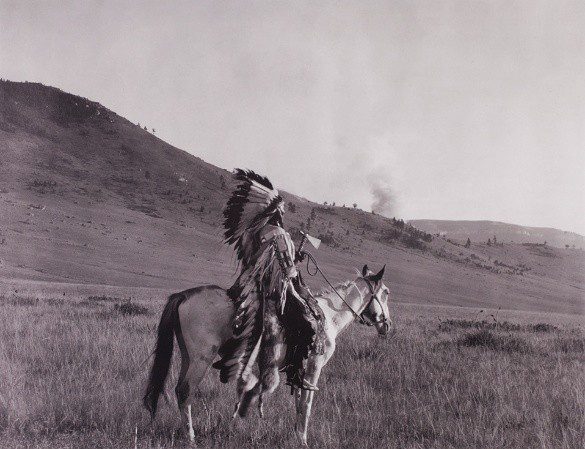
As a side note, while it’s unclear how the search engines generated the name Winifred Dixon, it is interesting to note the aforementioned Alice Fletcher had correspondence with one Joseph K. Dixon. As the National Museum of the American Indian states, “Joseph K. Dixon was a photographer best known for his portraits of the Indigenous peoples of North America. Beginning in 1908, Dixon led three expeditions, sponsored by philanthropist and department store magnate Rodman Wanamaker, to document the lives and cultures of Native peoples of the United States through photography, film, and sound recordings.
These trips were inspired by Wanamaker and Dixon’s belief that Native Americans were fated to become a “noble, though vanishing race,” a popular notion used to justify the violent tides of westward expansion during the nineteenth century. As such, Dixon used tools such as celluloid overlays to create “sunset” effects around his subjects and often strategically staged scenes before capturing them. Despite these manipulations, Dixon’s eight thousand negatives provide an invaluable record of Indigenous life.” See some of his photos at https://art.state.gov/personnel/joseph_dixon/
My own method for researching historical figures relies heavily on genealogy, and so, setting AI aside in favor of good, old-school research, began my searches for “Winifred Alice Dixon (1866-1891)”, “Mrs. George Truman Kercheval”, and “Mrs. Winifred Jennings.” Slowly, through family trees, newspaper accounts, footnotes in related books, a few clues rose to the surface. Each clue refines the knowledge of a particular person and thus refines the search parameters.
As Rich had pointed out in his article, “Historically, there are many instances of women authors hiding behind men’s names.” Her pseudonyms served their purpose, and the identity of Winifred was well hidden from history.
Her knowledge of Native Americans, her passion to see them in the light of their own culture, brought her to the level of one of the first anthropologists of the late 1800s, who was unable to speak because she was a woman.
I became obsessed with bringing her into the light.
And so, I introduce to you a biography of Winifred Agnes (Jennings) Cowley (1859-1924), a woman who quietly wrote about the transgressions wrought against Native peoples, and just as quietly disappeared from our history.
I. Ancestral Foundations: The Jenney/Jennings Lineage, 1285–1859
Winifred Jennings Cowley was born in 1859 into a family whose documented lineage extends more than seven centuries. Her paternal line descends from Thomas Jenney (Degyney), born in 1285 in Knotishall, Suffolk, a member of the medieval English gentry whose descendants held land and public office across Suffolk and Norfolk.[1]
Over successive generations, the family produced clerks, magistrates, ministers, and soldiers—roles that reflected a longstanding tradition of literacy, civic duty, and engagement with public life.
By the sixteenth century, the family had established itself in Gressingham, Lancashire, where Sir Henry Ralph Jenney (1560–1619) became a prominent figure.[2] His descendants participated in the Great Migration to New England, including John Jennings (1596–1644) and his wife Sarah Carey (1590–1655/56) of Monk Soham, Suffolk, who settled in Plymouth Colony.[3]
From Plymouth, the Jennings family spread into New York, then westward into Ohio, Indiana, and Michigan. Winifred’s father, Capt. Gilbert S. Jennings, belonged to this New York branch. On a parallel track, the Louisa M. Jennings within my own family tree descends from the same line through Benjamin → Zebulon → David → Levi → John. These shared ancestries place Winifred, and Louisa, within a family culture steeped in education, public service, and moral engagement—traits that shaped Winifred’s later advocacy for Native peoples.
II. Childhood on the Frontier: Omaha and Otoe Country, 1867–1878
Winifred’s formative years unfolded on the post–Civil War frontier, where her father served in the 43rd U.S. Infantry and later the 1st U.S. Infantry. Between the ages of eight and nineteen, she lived in and around:
- The Omaha Reservation
- The Otoe-Missouria Reservation
- Fort Omaha and associated agency posts
These years coincided with profound upheaval for both tribes. Federal allotment policies, missionary pressure, and the ideology of Manifest Destiny threatened to dismantle communal landholding, suppress ceremonies, and fracture tribal governance.[4]
Unlike most white Americans of her era, Winifred experienced Native communities not as abstractions but as neighbors. She played with Omaha children, listened to Otoe elders, and witnessed the emotional toll of federal intrusion. These relationships gave her a rare perspective: she saw Native nations as living, sovereign, culturally rich communities, not as remnants of a “vanishing race.”
III. A Literary Voice Against Manifest Destiny – Writing as George Truman Kercheval
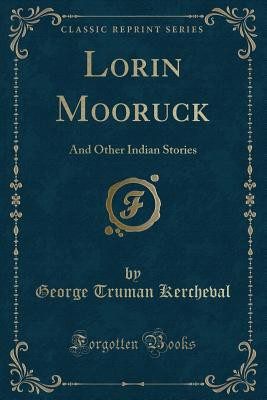
In the 1880s, Winifred began publishing under the male pseudonym George Truman Kercheval, a strategic choice that allowed her to enter literary and ethnographic spaces often closed to women. Her major work, Lorin Mooruck; And Other Indian Stories (1888), used sentimental fiction to humanize Native characters for white audiences conditioned by frontier mythology.[5]
Her approach paralleled that of Helen Hunt Jackson, whose novel Ramona sought to expose injustices against Native peoples. A review of Helen’s life and success/failures as a writer can be read here: Helen Hunt Jackson’s Ramona Did What Her Nonfiction Couldn’t – JSTOR Daily Or read Ramona yourself here:
https://oregontrailgenealogy.com/wp-content/uploads/2026/03/Ramona.pdf
But Winifred’s writing differed in one crucial respect: it was grounded in firsthand experience. Her stories reflect:
- Omaha kinship structures
- Otoe ceremonial life
- The emotional realities of cultural loss
- The dignity of Native governance
- The resilience of families under pressure
Her fiction was not nostalgic; it was a quiet act of resistance against the cultural violence of Manifest Destiny.
IV. Preservation vs. Assimilation: A Nuanced Reform Position
The Dawes Act of 1887 sought to assimilate Native Americans by breaking up communal lands. Reformers like Alice Cunningham Fletcher, who worked directly with the Omaha, believed allotment would “save” Native individuals by forcing them into Euro-American norms.[6]
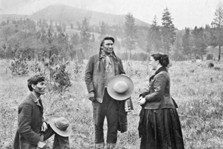
Alice C Fletcher in Lapwai Idaho 1899 Photo Jane Gray
The meeting with Joseph in the photo above took place several years after the period 1889-1892 when Alice was in north Idaho as the assigned Indian Agent. “Charged with supervising the daunting task of resurveying, verifying, and assigning nearly 757,000 acres of the Nez Perce Reservation, Fletcher also had to preserve land for transportation routes and restrain white farmers and stockmen who were claiming prime properties. She sought to “give the best lands to the best Indians,” but was challenged by the Idaho terrain, the complex ancestries of the Nez Perce, and her own misperceptions about Native life.” [7]
Of note, Chief Joseph refused her offer of an allotment, choosing to return to the Wallowa. Under the Dawes Act, accepting an allotment would have required him to:
- Accept U.S. citizenship
- Accept the reservation boundaries as permanent
- Renounce all claims to any other lands
Joseph would not preside over the dissolution of his own community, as his entire life’s mission after 1877 was to regain the Wallowa Valley, the ancestral homeland of his people.
Traveling with her on her Nez Perce expeditions was Jane Gray, tasked with photographing their travels. Like the photographer Joseph K. Dixon (whose photo shown earlier is actually a staged and carefully tinted portrayal) and Edward S. Curtis (who spent decades creating his “North American Indian” series, a majority of them also staged), Jane Gray was there to document Alice Fletcher’s gracious bestowment of land to the Nez Perce, land that was historically theirs to begin with.
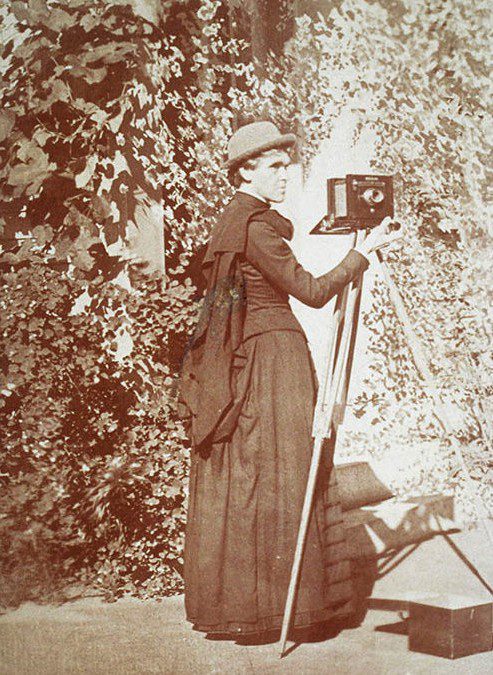
Alice Fetcher was a key player in the romanticization of Native Americans. Photography was a natural extension of that movement which created a frozen-in-time portrayal of “real” Native Americans. This romanticization had a profound and negative impact, replacing the diverse realities of countless Native American groups into static, idealized images that served the White settler’s interests. Portraying Native Americans as “children of nature” or “noble savages” framed them as incompatible with civilization.
Photographs, collections of artifacts for museums, written stories, and other means of capturing their essence, romanticizing these “native” people, were efforts to preserve the “vanishing Indian.” It helped to hide the realities of colonization and forced assimilation, recasting those events as bittersweet, inevitable consequences of progress. By turning Native Americans into symbols of a tragic, lost past, it framed their struggles as an inevitable act of nature rather than a result of the colonist’s specific laws and human choices. In short, open hostility towards Native Americans sought to destroy them, while romanticism replaced them with a certain character, and in both case the actual human beings, their history, culture, and their own needs, were ignored.
Winifred saw the consequences differently.
Winifred’s position was shaped by her childhood proximity to the Omaha and Otoe. She had seen the strength of their communities, the adaptability of their leaders, and the emotional cost of federal intrusion. This gave her a perspective that many reformers lacked:
- She understood why allotment appealed to some Native leaders.
- She also understood what would be lost if communal structures were dismantled.
- She believed that preserving culture was as important as protecting individuals.
Her writing became a form of resistance—not confrontational, but quietly powerful. By documenting stories, ceremonies, and worldviews, she created a literary archive that countered the assimilationist narrative.
Winifred Jennings Cowley stands apart from her contemporaries because she blended:
- Ethnographic accuracy
- Emotional intelligence
- Firsthand experience
- A preservationist ethic
Her work shows that she did not see Native cultures as fragile or doomed. She saw them as resilient, deserving of respect, and capable of surviving the pressures of the late nineteenth century—if their stories were preserved and their voices heard.
Her stance raises a natural question about how her later writings reflected the long-term consequences of allotment and assimilation, especially as she watched the Omaha and Otoe navigate the decades after the Dawes Act. Her 1893 article in the Journal of American Folklore, “An Otoe and an Omaha Tale,” treated Indigenous oral tradition as a scholarly subject worthy of respect, not as a curiosity.[8]
V. The Sacred Pole (Umon’hon’ti): Advocacy in a Moment of Crisis
In 1888, the Omaha Nation made the extraordinary decision to entrust their Sacred Pole (Umon’hon’ti) to the Peabody Museum at Harvard University. Many outsiders misunderstood this as a surrender of tradition.
Winifred understood it as a strategic act of cultural survival.
She documented the event as a deliberate effort to protect the Pole during a period when its safety was threatened by federal policy and missionary pressure. Her writing emphasized:
- Omaha sovereignty
- The emotional gravity of the decision
- The intention to preserve the Pole until it could be reclaimed
Her interpretation stands as one of the earliest examples of a white American writer publicly defending Native cultural autonomy.[9]
Read the story of Umoⁿ’hoⁿ’ti here: A SACRED OBJECT AS TEXT – RECLAIMING THE SACRED POLE OF THE OMAHA TRIBE by Robin Ridington https://omahatribe.unl.edu/etexts/oma.0021/index.html
VI. Later Life and Legacy
Winifred eventually married, becoming Winifred Jennings Cowley, and remained in Detroit for the rest of her life. Though her published output diminished after the 1890s, her earlier works continued to circulate, and her identity remained obscured behind her pseudonym.
She died in 1924, leaving behind a body of work that stands as a testament to a woman who bore witness to one of the most turbulent periods in Native American history.
- She was one of the few 19th‑century American writers who portrayed Native nations with empathy and accuracy.
- She challenged the “vanishing race” myth at a time when it dominated public thought.
- She preserved stories and cultural knowledge that might otherwise have been lost.
- She used literature to resist the violence of Manifest Destiny.
She stands as one of the earliest female advocates for Native cultural rights in American letters.
Winifred Jennings Cowley’s life and writing place her at the intersection of:
- U.S. military frontier history
- Omaha and Otoe cultural history
- Women’s literary activism
- Early American ethnography
She was not a political lobbyist, nor a missionary, nor a government agent. She was something rarer: a cultural mediator who used literature to preserve what policy threatened to erase.
Her story, “Three Men from Wallowa“, serves as an example. With some literary license and a touch of the romanticism, she weaves a love story alongside the historical realities of the time. Woven into the story are lines that reflect her true feelings about the injustice toward Native peoples: “What Western jury would agree in finding a white man guilty who had stolen from an Indian? A Pole, an Irishman, a Swede, a German, a negro, has the protection of the law, but an American Indian is helpless. He has no redress save that of war.“
It feels like reading a novel, until you peer between the lines:
Her stories remain among the most intimate and empathetic portrayals of Great Plains Native life written by a 19th‑century American woman.
Through my own genealogical work, she stands also as a member of my extended family, part of the same centuries‑long Jennings/Jenney lineage that shaped my own ancestry. As a young boy growing up in the land of the Nimi’ipuu in northern Idaho, I cannot remember exactly what influenced my fascination with Native peoples, other than the fact that traces of their culture surrounded me.
Devouring every book on Indians at the Latah Co. Library, and later, absorbing Native American History at my university, their history remains an undertone to my writing and examinations of families that crossed the Oregon Trail. It is with some pride that I can now include this remarkable woman, this distant cousin, as part of my family.
It is also with some degree of pride that I have been able to draw the curtain on her pseudonym, bringing her life and literary accomplishments to light.
Notes and Citation Placeholders
- Suffolk Record Office, Knotishall Parish Registers, 13th–14th c.
- Lancashire Archives, Gressingham Manor Papers, 16th–17th c.
- Plymouth Colony Records, Vol. 1–3.
- U.S. Office of Indian Affairs, Omaha Agency Reports, 1865–1880.
- Kercheval, George Truman. Lorin Mooruck; And Other Indian Stories. Detroit, 1888.
- Fletcher, Alice C. Indian Education and Civilization. Senate Doc. 1900.
- Dividing the Reservation, Alice C. Fletcher’s Nez Perce Allotment Diaries and Letters 1889-1892 by Nicole Tonkovich, https://wsupress.wsu.edu/product/dividing-the-reservation/
- Cowley, Winifred (as Kercheval). “An Otoe and an Omaha Tale.” Journal of American Folklore, 1893.
- Peabody Museum Archives, Sacred Pole Correspondence, 1888.
Other Source Material:
Lorin Mooruck: And Other Indian Stories by George Truman Kercheval, Winifred Jennings Cowley (note author’s names) https://archive.org/details/lorinmooruckand00cowlgoog/page/n6/mode/2up
An Otoe and an Omaha Tale by Kercheval, George Truman https://archive.org/details/jstor-533008/page/n1/mode/2up
While the two books listed above are the culmination of Winifred’s published work, what goes unseen is a tremendous output of letters to the editor, sprinkled in newspapers from the East to the West coast over a number of years, in which she takes on assimilation, allotment and other governmental policy, and passionately writes in support of Native culture. All of her letters to the editor are signed George Truman Kercheval.
Sample newspaper letters referring to Winifred Jennings being George Trumam Kercheval https://www.newspapers.com/image/1048563927/?match=1&terms=George%20Truman%20Kercheval
Friends of Indians, 1888 by Rich Wandschneider | Mar 27, 2026 https://library.josephy.org/friends-of-indians-1888/#comment-415
A stranger in her native land : Alice Fletcher and the American Indians by Mark, Joan T. https://archive.org/details/strangerinhernat0000mark/mode/2up
Alexander Cowley Obit – https://www.newspapers.com/image/1049392410/
Guide to MS 4558 Alice Cunningham Fletcher and Francis La Flesche papers, 1873-1939 – Smithsonian Archives, https://sova.si.edu/record/naa.ms4558?s=0&n=10&t=K&q=*&i=0 where correspondence with Joseph K. Dixon can be found
The Jennings lineage:
https://www.ancestry.com/family-tree/tree/109945921/family?cfpid=292216883158
https://www.ancestry.com/family-tree/tree/160106810/family?cfpid=382120167165
https://www.ancestry.com/family-tree/tree/196550788/family?cfpid=282564204106&fpid=282564204106
https://www.ancestry.com/family-tree/tree/159182275/family?cfpid=312099209021
https://www.ancestry.com/family-tree/tree/13454157/family?cfpid=272390137215&fpid=272662603785
https://www.ancestry.com/family-tree/tree/47443605/family?cfpid=152247997867
Post on Daughters of the American Revolution (DAR) report of Jennings lineage https://www.facebook.com/NationalPikeChapterDAR2140/posts/from-lineage-book-4-of-nsdarelizabeth-jennings-bates-1853-1929-first-picture-was/954076470170876/
Winifred Jenning’s Find-A-Grave w/ links to other family members https://www.findagrave.com/memorial/8595738/winifred_agnes-cowley